Imagine you have a watch that isn’t working.
You might still wear it to dinner because it works perfectly with what you’re wearing. Maybe it was a gift from your father. Maybe it has some meaning attached to it. Or maybe you just like having it on your wrist.
Nobody is going to stop you and check whether it’s actually telling the right time.
At that point, the watch is doing more than telling time.
It’s also something you wear.
And that leads to a question I’ve been thinking about with wearable electronics:
If you removed the electronics, would there still be something here that someone would want to wear?
Now, obviously, I don’t think this is the right question for every wearable.
If you’re designing a medical sensor, a safety device, or something someone wears while running, you may have much more important things to solve first.
But if you’re designing a visible consumer product that might stay on someone’s body for hours, I think it’s a useful question.
Because once electronics become something we wear, we’re not only designing a gadget anymore.
We’re designing something that has to belong on a person.
Wearable electronics design brings body fit, personal expression, component architecture, and manufacturing together. In this article, I use my Elara earbud concept to explore those relationships through what I call the Four Fits of a Wearable: body fit, identity fit, architecture fit, and production fit.
Wearables are not just smaller electronics
It’s very easy to treat a wearable like a packaging problem.
We have a PCB.
We have a battery.
Maybe an antenna, speaker, sensors, microphones, controls.
Now let’s make everything small enough and put it somewhere on the body.
And of course all of that matters.
But the moment the product touches the body, the problem changes.
Now we have anatomy.
Movement.
Pressure.
Weight.
Contact points.
Retention.
Comfort.
Research into wearable design keeps finding the same kinds of things. Comfort, fit, materials, weight, battery life and how the product attaches to the body all affect wearability.
And then there is another problem.
People can see it.
A router can sit behind your monitor. Nobody really cares what relationship it has with your outfit.
A wearable is different.
Its shape, material, size and visibility can become part of how you look.
And this is where I think a lot of wearable electronics still feel very much like gadgets.
Sometimes almost like call-center equipment.
They solve the technical problem, but visually they don’t really add anything to the person wearing them.
So the competition isn’t always another electronic product.
Sometimes the competition is everything else that person already chooses to put on their body.
Are we designing a wearable, or are we just packaging electronics close to the body?

Jewelry is more than an aesthetic reference
This is basically how I ended up with Elara.
I was looking at open-ear earbuds and thinking about how we’re using them.
They aren’t necessarily something you put on for twenty minutes and take off again.
You can walk around with them.
Work with them.
Take calls.
Talk to AI.
And with open-ear products, you can still hear what’s happening around you.
So at some point, they start feeling less like something you use and more like something you wear.
And I started thinking:
Why do they still need to look like gadgets?
We already have something people have been wearing around their ears for thousands of years.
Jewelry.
So instead of starting with an earbud and trying to make it prettier, I reversed the question:
What does an earbud look like if we actually start with jewelry?
That’s a small difference in wording, but I think it changes the whole project.
“Make this earbud look more like jewelry” means the electronic product already exists. The jewelry part comes later.
Starting with jewelry means I first have to ask why people wear these things at all.
And it’s obviously not only because they look nice.
Jewelry can say something about taste.
Identity.
Belonging.
Status.
Personality.
Sometimes it has sentimental value.
Sometimes it’s quiet.
Sometimes it’s intentionally loud.
Research around adornment and expressive wearables points in the same direction. Identity and social meaning are not side issues once technology becomes part of someone’s appearance. Social acceptability and identity conflicts can become part of whether those products actually fit into people’s lives.
So jewelry is interesting to me for much more than gold, rings and polished surfaces.
It gives us a whole language for objects people choose to make visible on their bodies.
And that gives us another question:
What should this product communicate before anyone even knows what the technology does?
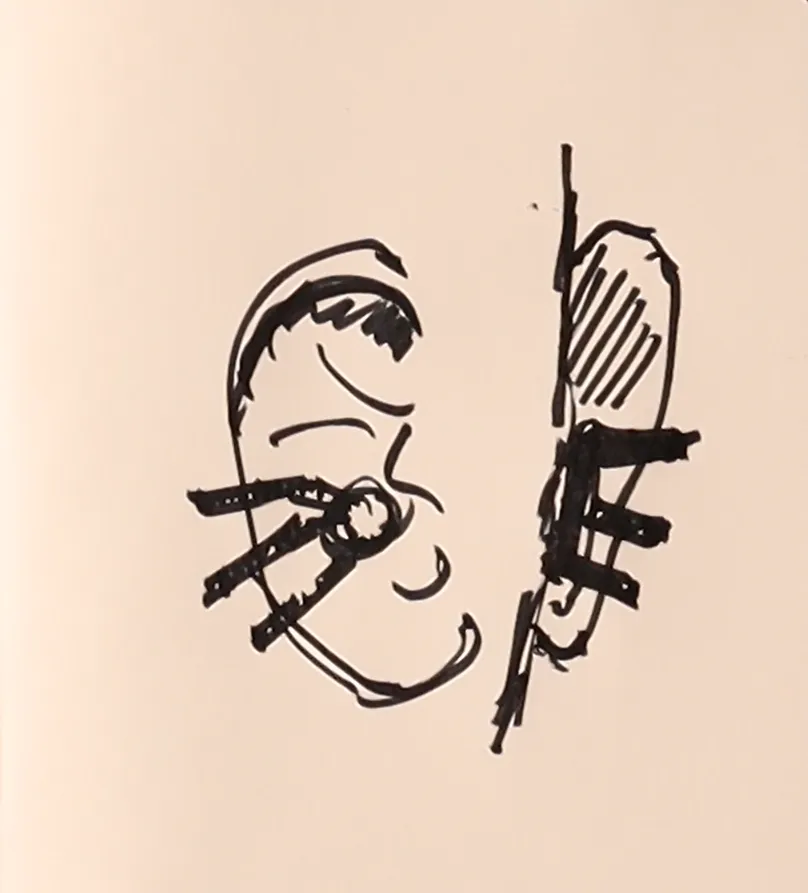
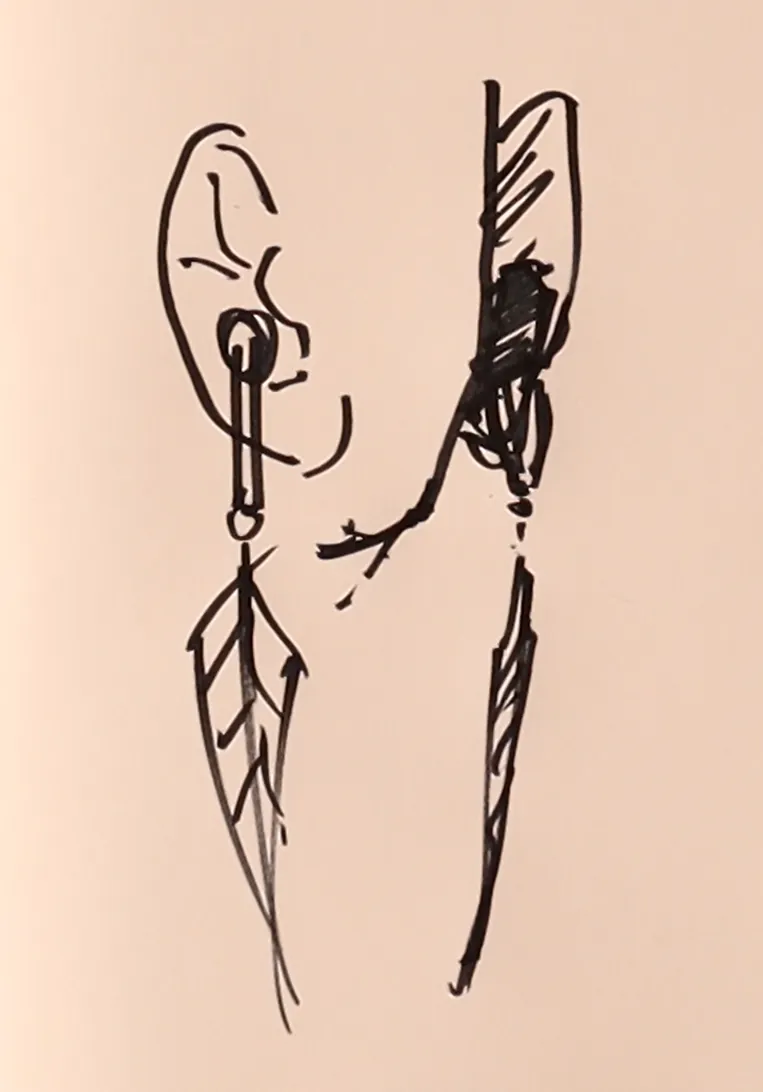
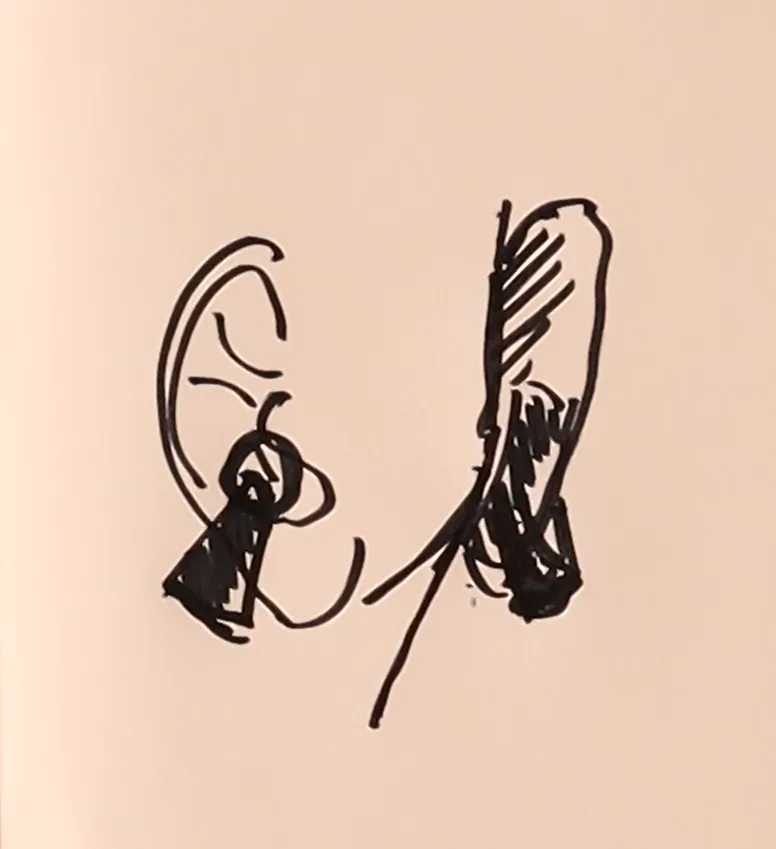
Three directions from the same starting question
The Four Fits of a Wearable
While I was working through Elara, I started thinking about wearable products in four different ways.
I call them the Four Fits of a Wearable.
The Four Fits of a Wearable
Four dimensions / one product
Product
Body fit
Works with the body
Identity fit
Belongs to the person wearing it
Architecture fit
Supports the product idea
Production fit
Survives becoming real
The weighting changes with the product, user and context.
Body fit
First, does it actually work on the body?
Where does it touch?
How does it stay there?
Does it move?
Does it create pressure?
What happens after an hour?
What happens after four hours?
This sounds obvious, but CAD can only take you so far.
You can make something look perfectly comfortable around a digital ear, wrist or head.
That doesn’t mean it actually is.
At some point you have to put it on real people and test it.
Identity fit
Then there is a completely different kind of fit.
Does this object actually belong to the person wearing it?
Some people want technology to disappear.
Some people want it to look like a normal accessory.
Some people want exactly the opposite. They want something big, visible and expressive.
And I think consumer electronics are still a little limited here.
A lot of the time personal expression means:
Same product.
Black.
White.
Maybe pink.
And there is nothing wrong with that.
It’s efficient. For many products it makes complete sense.
But when we’re talking about something you actually wear, I think we can go further than color.
The proportions can change.
The silhouette can change.
One version can almost disappear.
Another one can have much more presence.
Elara Option A is intentionally a more feminine expression.
I wouldn’t personally wear it.
But I can imagine someone wearing it all day in the office, taking meetings, listening to things, talking to AI, without feeling like she needs to choose between jewelry and an audio device.

That’s a very different design target from a sport earbud.
Architecture fit
Then we have the electronics.
Can the product architecture actually support the product idea?
Where does the battery go?
The PCB?
Speaker?
Sensors?
Microphones?
Antenna?
Charging contacts?
Controls?
And which of those things really can’t move?
That’s a question I like to ask because sometimes we treat something as fixed simply because somebody designed it first.
Maybe it actually has to stay there.
Maybe it doesn’t.
Those are very different situations.
Production fit
Eventually, we need to consider moving from prototype to manufacturing.
Materials.
Assembly.
Durability.
Sealing.
Tolerances.
Manufacturing.
Production variability.
A beautiful concept can work on the body, fit the user and package the electronics perfectly, then still fall apart when you try to make thousands of them.
So I think about these four fits together:
Body. Identity. Architecture. Production.
But here’s the important part:
They don’t all matter equally in every product.
A running earbud might put body fit and retention much higher.
A health wearable may care much more about sensor placement, skin contact and discretion.
A visible consumer wearable may put much more pressure on identity fit.
There isn’t one correct weighting.
The question is:
Which fit matters most for this product, and what are we willing to trade away?
When the visual idea starts doing functional work
This is where Elara became much more interesting to me.
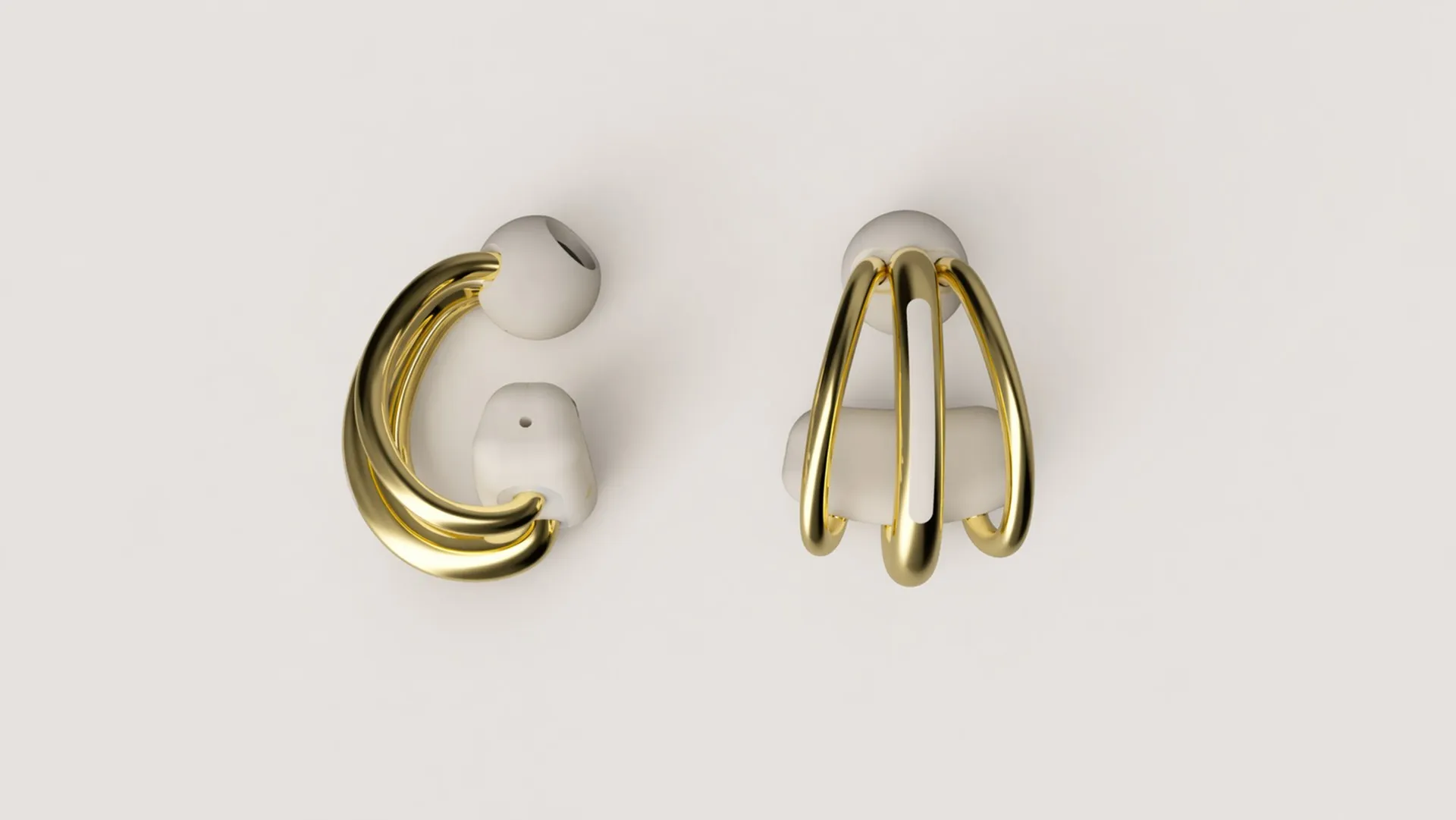
I had this three-ring idea.
At first, honestly, the rings were mostly there because I liked the composition.
They gave me the jewelry feeling I was looking for.
But then I brought the design into CAD and started working at actual scale.
Now I needed a real speaker.
Somewhere for the electronics and battery.
Microphones.
Controls.
Connections.
And one of the rings started getting slightly thicker.
That ring could connect the speaker to the rear housing.
And because it already had more surface area, it also gave me a natural place for a larger touch control.
The other two rings didn’t have to do all of that.
They could stay lighter and do more of the visual work.
And that’s where the design stopped feeling like an earbud with jewelry added on top.
The jewelry idea itself was starting to do functional work.
There was another thing I liked about this.
Jewelry sometimes needs volume.
That’s part of why people notice it.
And electronics need volume too, but for completely different reasons.
Maybe you need a larger battery.
Maybe you need a better place for the control surface.
Maybe you need space for a connection or some structure.
So these two things don’t always have to fight each other.
If I want visual presence anyway, maybe that volume can actually help me.
Now the design idea isn’t only creating problems for engineering.
It’s giving engineering something to work with.
A strong visual idea can create technical opportunity instead of only creating technical constraints.

What must survive optimization?
Now imagine an engineer comes back and says:
“We can make this 30% smaller.”
Maybe lighter too.
Maybe slightly cheaper.
Okay.
But why?
What are we actually gaining?
And more importantly:
What are we losing?
For Elara Option A, the visual presence is part of the product.
If I keep shrinking those rings because technically I can, at some point the design isn’t doing the same job anymore.
I might reduce a little material.
Maybe save some small amount of cost.
But if the product isn’t meaningfully cheaper to ship, doesn’t change the packaging, and doesn’t create a real user benefit, why am I removing the thing that gives the product its identity?
Now, comfort is different.
If testing tells me the product is too heavy or uncomfortable, of course I care.
That’s user experience.
But if the goal is simply “make it smaller because smaller sounds better,” I would be much more careful.
And actually, this is why I explored other Elara directions.
If I want something quieter, smaller and more neutral, maybe I shouldn’t keep compromising Option A.
Maybe that’s Option C.
Maybe it’s a different product.
That’s why I think this question is useful way beyond wearables:
What must survive optimization?
Cost matters.
Size matters.
Weight matters.
Manufacturability matters.
But they don’t automatically outrank the reason the product exists.
Sometimes optimization is actually a request for another product.
Are we improving this product, or are we quietly turning it into something else?
What Must Survive Optimization?
- Smaller
- Lighter
- Cheaper
- Easier to manufacture
What must
survive?
- Visual presence
- Jewelry identity
- Comfort
- Product purpose
same directionorDifferent
product direction
One product doesn’t need one expression
When I was sketching Elara, I didn’t try to find the answer immediately.
I just dumped ideas onto paper.
Rings.
Hooks.
Hanging pieces.
Stones.
Different ways of attaching things around the ear.
And eventually three directions felt strong enough to keep.
Option A became the three-ring direction.
Option B explored something more changeable, where the electronics could stay more consistent while the jewelry element changed.
Option C moved in a simpler and more neutral direction.
And I like that they’re actually different.
They’re not three tiny variations of the same idea.
Because at that stage, why would I assume there is only one answer?
There is an idea from psychology that fits really well here called optimal distinctiveness.
The basic idea is pretty simple.
We want to belong, but at the same time, we still want to feel like ourselves.
Brewer’s original theory describes that tension as a balance between assimilation and differentiation.
And you can see that in the things we wear.
People wear the same category of shoes.
The same general kind of glasses.
The same type of watch.
But they still choose versions that feel more like them.
Wearable electronics can do that too.
That doesn’t mean every brand needs twenty different product versions.
But it does mean that one universal shape plus several colors is not necessarily the only way to think about personal expression.
Sometimes different users genuinely want different answers.
When should a wearable disappear?
There is this idea that good technology should disappear.
And sometimes I completely agree.
If someone has to wear a medical device, for example, they may not want the product announcing their medical condition to everyone around them.
Maybe the product needs to blend into clothing.
Maybe it can feel more like jewelry.
Maybe it just needs to be much quieter visually.
Research into health and expressive wearables has also found that identity, aesthetics and social acceptability can affect whether people are comfortable wearing these products publicly.
But I don’t think disappearing should be the rule.
Look at large headphones.
People intentionally wear huge ones.
Some products even have cat ears or other decorative elements.
Some watches are designed to be noticed.
Jewelry obviously can be designed to be noticed.
So I think there are roughly three places a wearable can sit:
Disappear.
Belong.
Stand out.
And the right place depends on the user and what the product is supposed to do.
For Elara Option A, I wouldn’t want it to disappear.
That would defeat the point.
I want someone to notice the jewelry first.
But I also don’t want it to look like someone strapped a strange piece of technology to their ear.
It should belong with the person.
That’s the middle.
And another product may sit somewhere completely different.
A wearable shouldn’t automatically disappear. It should belong.
Disappear / Belong / Stand out
How visible should the wearable be?
Disappear
Discreet sensing / low visibility
Belong
Everyday visible personal object
Stand out
Expression is part of the value
A design-thinking spectrum, not a scientific scale.
Technical reality still gets a vote
Of course, none of this makes the engineering disappear.
Wearables get multidisciplinary very quickly.
If I’m designing an ear-worn audio product, maybe I need an acoustic engineer.
If the housing is metal and I need reliable wireless performance, maybe I need RF expertise.
If I’m reading something from the body, maybe sensor placement becomes critical.
If it’s a medical product, now I may need medical-domain specialists, materials expertise and regulatory guidance.
And that’s completely fine.
My role is to connect the product experience, design intent, and technical decisions, working with the right specialists as the product develops.
Because the user doesn’t experience any of those disciplines separately.
They don’t say:
“The RF engineer did a great job, but the industrial designer didn’t.”
They experience one product.
It either works for them or it doesn’t.
So for me, the industrial-design role sits somewhere in the middle.
Think like the user.
Understand the engineering.
Understand how it’s going to be made.
Know where your own expertise ends.
And then keep all of those decisions connected.
Five questions I would ask before detailing a wearable
Before going too far into CAD, I would want answers to these:
-
Who is this actually for, and where are they going to wear it?
-
What really needs to interact with the body? Where does it touch, grip, sense, transmit sound or need to stay in position?
-
Which technical constraints are genuinely fixed, and which ones were just decided first?
-
What part of the product’s identity has to survive engineering, design for manufacturing (DFM) and cost optimization?
-
What do we need to physically test before the architecture becomes expensive to change?
Those aren’t really industrial-design questions.
Or engineering questions.
Or business questions.
They’re product questions.
And I would rather ask them before everybody gets attached to one CAD model.
The useful part of Elara wasn’t the three gold rings
Elara started because I changed the starting point.
Instead of beginning with electronics and asking how I could make them look better, I started with something people already choose to wear.
Then I tried to make that into an electronic product.
Option A is one answer.
The three gold rings themselves aren’t really the lesson.
The useful part is what happened after I started from that question.
Now identity entered the project earlier.
The body entered earlier.
Then the electronics came in and started pushing back.
I needed somewhere for the battery.
The speaker had to sit in the right place.
I needed controls.
Microphones.
Charging.
The product still had to stay on the ear.
And that’s where the interesting work happened.
Not in choosing between jewelry and engineering.
In figuring out how those things could become the same product.
So I don’t think every wearable should look like jewelry.
And I don’t think every wearable should disappear.
I think it depends on who it’s for, what it does, and what kind of role it’s supposed to have in that person’s life.
But for visible consumer products, I still like coming back to the same question:
If you removed the electronics, would there still be something here that someone would want to wear?
Sometimes the answer doesn’t matter.
Sometimes it changes the whole project.